Updated October 2026 · Written by Tauseef Shah, founder and CEO of Growthkeel
How long does SEO take? Somewhere between 3 and 6 months before you notice anything worth reporting, and 6 to 12 months before it changes your business. That’s the honest range, not a marketing promise.
Here’s what most SEO articles won’t tell you though. There’s no switch that flips on month four. Google’s own SEO Starter Guide admits changes can show up in hours or take several months, and it depends on the page you’re working with. Years ago, Maile Ohye, who led part of Google’s Search team, said something that still holds up today: SEOs typically need four months to a year just to implement fixes and start seeing anything from them.
Ahrefs ran a poll on LinkedIn and X, got 3,680 responses, and landed on roughly the same window, 3 to 6 months for early progress. But there’s a second, meatier piece of Ahrefs research worth knowing about. They looked at over 2 million pages and found that only 1.74% of newly published content makes it into Google’s top 10 within its first year. Back in 2017, that number was 5.7%. The average page sitting at position one right now is about five years old. Read that twice if you have to, because it says more about why SEO takes so long than any timeline chart could. You’re not competing against an algorithm. You’re competing against pages that had years to earn where they are.
So the next time someone tells you “SEO takes six months, guaranteed,” push back a little. A brand new site chasing “SEO agency Pakistan” is nowhere near the same fight as an established business going after “dentist in Islamabad” or “property dealer in DHA Lahore.” Where you’re starting from matters just as much as how much effort you put in.
How Long Does SEO Take to Start Working?
Early on, SEO gives you hints, not headlines. A page gets crawled. Then indexed. Then it quietly starts showing up for weird long tail phrases you never even targeted. Impressions creep upward in Google Search Console. A ranking that was buried on page five slides to page three, and eventually page two.
None of that pays the bills yet. It just tells you the machine is working.
If you want the full sequence, it looks roughly like this: crawling, indexing, impressions, rankings, clicks, qualified traffic, leads, sales, and finally revenue. Every one of those steps can quietly break down. Getting indexed doesn’t mean you’ll rank. Ranking doesn’t mean anyone clicks. A click doesn’t guarantee a lead. Traffic by itself proves nothing about profitability. Google Search Console’s documentation is pretty clear that you’re supposed to watch impressions, clicks, queries, and pages together, not obsess over one metric in isolation.
What to watch for in the first few weeks
You might notice priority pages getting indexed faster than expected. More impressions showing up in Search Console. A handful of long tail queries you never planned for. Small ranking movements that feel insignificant but aren’t. Wider crawl coverage across the site. For local businesses specifically, this often shows up as extra Google Maps visibility, a few more calls, or people asking for directions who weren’t calling before.
A better ranking isn’t automatically a win
Say a plumber in Rawalpindi ranks first for some low volume, purely informational phrase. Looks impressive in a monthly PDF report. Means almost nothing if that’s not what people type when their pipe bursts at 2am.
The question worth asking isn’t “did my ranking go up.” It’s whether your site got more visible for the searches that turn into paying customers. That’s the whole reason calls, form fills, bookings, and sales need to be part of the plan from day one, not an afterthought once someone asks “so where’s the ROI.”
How Long Does SEO Take to Show Meaningful Results?
Here’s a rough framework, pulled from what Google and Ahrefs have both said publicly.
| Period | What you may see |
|---|---|
| Month 1 | Audit, technical fixes, keyword research, a baseline to compare against |
| Month 2 | On page improvements, content work, better internal linking |
| Month 3 | More impressions, indexing progress, first signs of ranking movement |
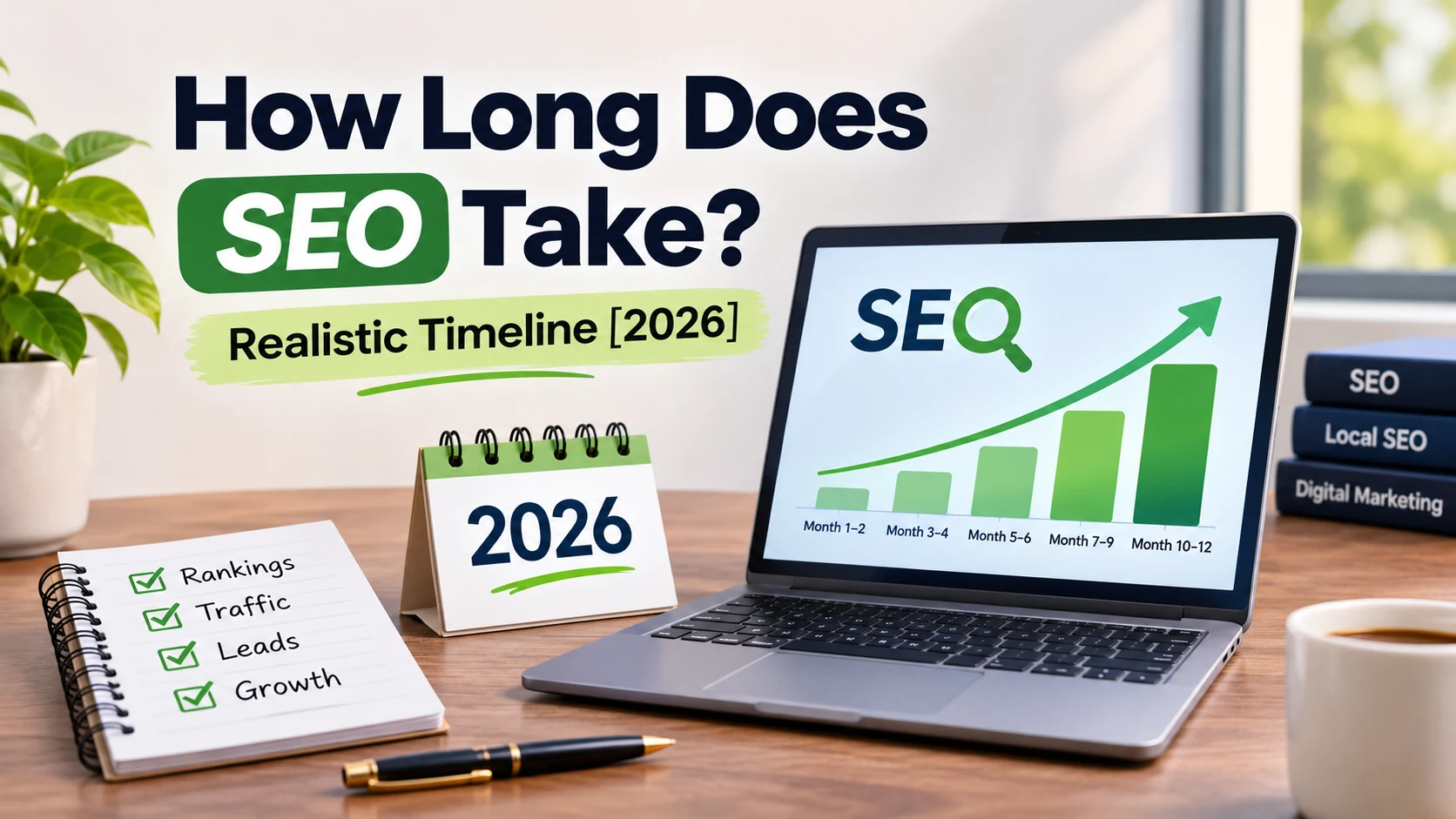
| Months 4 to 6 | Stronger rankings, real traffic growth, better visibility |
| Months 6 to 12 | Wider keyword coverage, stronger pages, commercial traffic |
| 12 months plus | Continued growth, assuming the market and competition allow it |
Treat this as a planning tool, not a promise carved in stone. A quiet local keyword with barely any competition can move in a matter of weeks. A national commercial term might take a year or longer just to sniff the top 10, and remember, fewer than two out of a hundred new pages manage that in their first year at all.
What Should You Expect From SEO in the First 3 Months?
Month 1 is mostly diagnosis
Month one usually surfaces problems nobody knew existed. Crawl issues, broken links, redirect chains that go nowhere useful, duplicate content fighting itself, weak canonical tags, thin internal linking, mobile pages that render like it’s 2014, and conversion tracking that was never set up properly. Google’s own advice on this is refreshingly simple. Make it easy for search engines to crawl, index, and understand the site before worrying about anything fancier.
This is also when real keyword and competitor research needs to happen, not the surface level version. “SEO services” and “SEO services Islamabad” aren’t the same search intent, even though they look similar. Someone typing “SEO agency Pakistan price” is a lot closer to buying than someone typing “what is SEO?” Your pages should reflect that gap instead of treating every visitor the same.
Month 2 is where implementation starts
Once the big problems are mapped out, month two becomes hands on work. Rewriting weak service pages. Building supporting content people search for. Tightening internal links so priority pages get more relevance passed to them. Fixing structure that’s been broken for years. Content at this stage should answer the actual question behind a search rather than dance around it. Someone searching “how much does SEO cost in Pakistan?” wants a number or a range, not a 1,500 word explainer on what SEO even is.
Month 3 is when you start asking sharper questions
By month three, there’s usually enough data to move past guessing. Are impressions climbing? Are new relevant queries showing up you didn’t plan for? Are the pages that matter getting indexed? Is anything inching toward page one? If everything is flat as a pancake, don’t just shrug and repeat “SEO takes time” like it’s gospel. Go find out why nothing’s moving.
What Happens From Months 4 to 6?
This stretch is usually when things become easier to judge fairly. Pages that were invisible start picking up positions. Content begins ranking for clusters of related searches instead of just the one phrase you targeted. Internal links start doing their job, passing relevance to the pages that need it most.
Rankings still bounce around, that’s just how search works. Landing at position 12 isn’t the same as position 3, and what the search result page itself looks like matters more than it used to. Featured snippets, local packs, and AI Overviews all eat into how much traffic a given ranking delivers now. So track visibility and clicks side by side, not just where you sit on the page.
What Happens After 6 to 12 Months?
By this point, SEO starts feeling like an actual growth channel instead of a hopeful experiment. More pages ranking. More keywords quietly generating impressions in the background. Stronger commercial pages doing the heavy lifting, better internal structure tying everything together, and finally enough conversion data to make real decisions from.
This is also when strategy needs to get more selective. Publishing anything with search volume attached stops making sense. For a business in Islamabad, that might mean focusing on Islamabad and Rawalpindi service pages, specific customer questions people keep asking, and honest commercial comparisons, instead of churning out loosely related blog posts nobody asked for.
Why Does SEO Take So Long?
There isn’t one neat reason. It’s a handful of things stacking on top of each other.
Google has to find and process your changes first, and crawling never stops, but that doesn’t mean the index updates instantly. Your competitors are moving at the same time too, which people forget. If ten businesses in your niche are all improving their sites simultaneously, your result depends partly on how you stack up against them, not just your own effort in isolation.
Content also has to match what people want. A 2,000 word article that talks around the question loses to a 400 word page that just answers it. And authority builds slowly, almost annoyingly so. Relevant links, mentions, and brand recognition take years, not weeks, which is exactly why that Ahrefs stat about five year old pages dominating position one isn’t some fluke. Buying a pile of cheap backlinks doesn’t skip this step.
Then there’s implementation speed, which matters more than most people admit. A technical fix sitting in an audit PDF does nothing. A content plan does nothing until someone publishes it.
Why Do Some Websites See Faster SEO Results Than Others?
A handful of things shift the timeline in real ways. An established site already carries indexed pages, existing links, and some track record with Google, while a brand new domain is starting from literally nothing. Competition matters too. Going after “restaurant Islamabad” is a completely different fight than a narrow, quiet local phrase nobody else is chasing.
Search intent plays a part as well, since commercial pages usually have a clearer road to conversion than broad informational ones. Site size counts too, a ten page site is far easier to fully optimize than an e commerce catalog with thousands of URLs. And technical health, content quality, and how consistently you publish all add up. A strategy that gets executed every week beats one that sits in a Google Doc gathering dust for a quarter.
How Long Does SEO Take for a New Website?
New sites need more patience, plain and simple, because there’s no existing visibility or authority to lean on. The mistake most people make is going straight for the hardest keyword available. Starting focused and low competition gets results faster. “SEO consultant Islamabad” is a far more realistic opening target than just trying to rank for the bare word “SEO.”
New sites should also resist padding the site with thin pages just to look bigger. Google leans hard on helpful, people first content, and it doesn’t hand out a fixed waiting period before new domains can rank. That cuts both ways. It can happen faster than you’d expect, or slower, depending entirely on how well the execution goes.
Can SEO Results Appear in Days?
You need to be honest about what “results” means here. Technical fixes can get crawled fast. A new URL can show up in search within days. Impressions can start almost right away. A quiet, low competition query might even move within a week.
That’s a completely different thing from consistent page one rankings, steady leads, or actual revenue. This gap is exactly why online experiences vary so widely. Some business owners see movement in weeks, others wait months, and both can be telling the truth about different websites competing in different markets.
How Long Does It Take for SEO Changes to Take Effect?
Technical changes can take anywhere from a few hours to several months, straight from Google’s own guidance. On page changes, updated titles, headings, all of that, need to be crawled and reprocessed before you can judge whether they worked. New content has to be discovered and indexed before it has any chance of ranking. Internal links help with discovery, but they don’t guarantee anything on their own, and backlinks definitely don’t follow some neat 30 day rule people love to quote. The link has to be found first, and the target page still has to satisfy search intent on its own merit.
How Long Does It Take for Backlinks to Work?
Backlinks aren’t a stopwatch you start and wait on. One relevant editorial link from a good site can outweigh a hundred random ones from irrelevant blogs. What matters is context, relevance, and the authority of the linking page, not the raw number sitting in a spreadsheet.
Google has never published a formula converting X number of links into Y ranking position, because that’s not how it works. A sound link strategy focuses on earning genuine mentions and real industry relationships, not bulk link schemes that look impressive in a report and mean nothing to Google.
How Long Does Local SEO Take?
Local SEO can move quicker than competitive national SEO, though there’s still no guaranteed clock. Google’s own local ranking guidance comes down to three things: relevance, distance, and prominence. Complete, accurate business information is what helps Google match a business to a local search in the first place.
For a business serving Islamabad, the searcher’s exact location matters a lot. A business near F7 competes differently than one near Bahria Town or I8, and the same logic applies across the country. A restaurant in Lahore, a clinic in Peshawar, and a service business in Multan are all fighting in separate local search environments, even though they’re all “local SEO” on paper.
Local SEO work usually covers Google Business Profile optimization, getting business categories right, location specific landing pages, generating reviews, local citations, keeping name, address, and phone details consistent everywhere, and tracking calls or direction requests properly. Track calls, visits, and enquiries here. Not just rankings.
What If Your SEO Agency Keeps Saying “It Takes Time”?
That phrase can be true. It still shouldn’t be the entire report though. A decent monthly update answers real questions: what got fixed, which pages changed, what content got published, which queries improved, and how traffic and leads moved.
Growthkeel, for instance, builds its process around technical audits, search intent research, content, authority building, local SEO, and conversion tracking, with reporting tied to actual business outcomes rather than vanity numbers.
Wondering what’s slowing your website down? Request a Free SEO Review from Growthkeel if your reports keep showing rankings but no leads.
SEO Timeline by Website Type
| Website type | Common challenge | What to measure |
|---|---|---|
| New website | Little history or authority | Indexing, impressions, long tail visibility |
| Established website | Technical debt, outdated pages | Rankings, traffic, page performance |
| Local business | Location based competition | Maps visibility, calls, enquiries |
| E commerce | Huge URL count | Category traffic, product visibility, sales |
| B2B | Low volume, high value | Qualified traffic, leads |
| National website | Strong competition | Non branded traffic, commercial rankings |
| Enterprise | Scale and complexity | Visibility, revenue, technical health |
SEO vs Google Ads: Which Produces Results Faster?
Google Ads can put a business in front of searchers within hours of a campaign going live. SEO takes longer because organic visibility has to be earned through relevance, technical accessibility, and content strength. There’s no checkout counter for rankings.
Paid traffic stops dead the second spend stops. Organic visibility keeps working long after the initial effort is done, though it still needs upkeep as competitors adjust. For a lot of businesses, running both at once makes the most sense. Paid search grabs immediate demand while SEO compounds quietly in the background, and the right mix depends on budget, margins, and how fast the business needs new demand.
Is SEO Still Worth It in 2026?
Search has shifted. Google AI Overviews and AI Mode now sit above traditional results for a huge chunk of queries, and more people are using AI tools directly to research products and services before typing into a search bar the old fashioned way.
Google’s own stance is that the same foundational SEO practices still apply to its AI features, and there’s no separate technical checklist required to appear inside an AI Overview. The basics still carry the weight: crawlable pages, clear indexed content, direct answers, solid internal structure, reliable facts, and clear information about who’s behind the business or content.
A page can now earn visibility on two separate tracks, ranking in the traditional results and getting pulled as a source inside an AI generated answer. These overlap, but they’re not the same thing, and that raises the bar for writing clearly. Answer the question early. Back it up with facts. Explain terms instead of assuming everyone already knows them. Use structured data only where it describes the page, not as a trick to game the system.
And the stakes here are real. Ahrefs’ own research into AI Overview click behavior found a 58% drop in organic click through rate for the top ranking result on queries that trigger an AI Overview. That’s Ahrefs’ number, not a Google rule carved in stone, but it’s still a strong argument for reporting on visibility and qualified traffic instead of obsessing over position alone. A number one ranking that nobody clicks isn’t the win it used to be.
How to Measure SEO Progress Month by Month
| Month | Main focus | Useful measurements |
|---|---|---|
| 1 | Technical foundation | Indexing, crawl health, baseline rankings |
| 2 | Page improvements | Indexed pages, impressions, page changes |
| 3 | Early traction | Queries, clicks, ranking movement |
| 4 to 6 | Growth | Organic traffic, commercial rankings, conversions |
| 6 to 12 | Compounding growth | Qualified traffic, leads, sales, revenue |
Adjust this whenever the website, market, or competitive landscape shifts in a meaningful way.
When Should SEO Start Generating Leads and Revenue?
There’s no universal month when every business magically gets its first lead. A local emergency service might convert off a tiny trickle of traffic, while a B2B software company may need dozens of visits before anyone picks up the phone for a sales call. An e commerce store can convert straight off a product page, but a property company might need several visits before a buyer commits to booking a viewing.
Lead generation depends on search intent, volume, competition, landing page quality, how strong the offer is, conversion rate, and how long the customer typically takes to decide. A simple way to frame ROI: SEO ROI equals revenue attributed to SEO minus SEO investment, divided by SEO investment, times 100.
The hard part is attribution. If a customer finds you through Google, comes back later through direct traffic, and finally picks up the phone, your tracking needs to connect that whole journey, not just credit the last click like it did all the work.
Common SEO Timeline Mistakes to Avoid
Expecting big results in 30 days trips up a lot of people. Some changes show fast, but real competitive growth just takes longer. Treating six months as some kind of guarantee is another trap, since it’s a benchmark, not a contract Google signed with you. Measuring only rankings misses the point too, because position is one input among many, not the whole story.
Chasing only high volume keywords can backfire, since a smaller commercial term often carries more actual business value. Publishing without checking intent rarely pays off, and ignoring technical problems is a quiet killer, since even great content can’t make up for pages Google physically can’t access. Buying bulk low quality links has never been a safe substitute for genuine relevance either.
Stopping too early undoes months of groundwork, since SEO needs repeated iteration based on real data, not a one time burst of effort. And confusing indexing with ranking leads to false confidence, because a page can be indexed and still get almost zero traffic.
Frequently Asked Questions About How Long SEO Takes
How long does SEO take to work?
Most websites see meaningful movement within 3 to 6 months, though the exact timeline depends on competition, site history, content, and technical health.
Can SEO work in 30 days?
Technical and indexing changes can show up within days or weeks. Major competitive rankings and steady business growth usually need longer than that.
How long does SEO take for a new website?
There’s no fixed period. New sites generally need more time to build visibility, content coverage, and authority than established domains already have.
How long does local SEO take?
Local visibility can sometimes shift within weeks after fixing obvious Business Profile or technical issues, though competitive local markets can still take months to move.
Why does SEO take so long?
Google needs time to discover and process changes, and your pages have to compete against others doing the same work at the same time. Some changes land fast, others take much longer.
How long do backlinks take to work?
There’s no reliable fixed number of days. Discovery, relevance, authority, and the target page’s own strength all factor into it.
How long should I give an SEO company?
Don’t judge by months alone. Look at completed work, technical improvements, search visibility, traffic quality, leads, and business outcomes together.
Is SEO worth it in 2026?
Yes, but measure traditional organic visibility alongside conversions and emerging surfaces like AI Overviews, since a ranking without a click matters a lot less than it used to.
Final Answer: How Long Does SEO Take?
For most websites, 3 to 6 months is a fair benchmark for meaningful early progress. Six to twelve months gives a clearer picture of wider organic growth. Competitive national searches take longer to crack. Local and lower competition searches can move sooner than that. New websites need more runway to build visibility from scratch, and technical problems can slow any of it down, while fast, solid implementation speeds the whole thing up considerably.
But the real measure isn’t how many months have ticked by. It’s what changed during them. Are priority pages indexed? Are impressions climbing steadily? Are qualified visitors showing up? Are calls, forms, or bookings increasing month over month? Is organic search producing revenue, or just vanity metrics for a report nobody reads closely?
That’s the real difference between waiting for SEO and measuring it.
Ready to find out what’s slowing your website down? Get a Free SEO Review from Growthkeel, a full look at your technical setup, search visibility, content gaps, local signals, and conversion path.
If you want to see how a complete campaign fits together, explore Growthkeel’s SEO services, or review actual Growthkeel case studies to compare starting points, work completed, and reported outcomes.