Updated October 2026 · Written by Tauseef Shah, founder and CEO of Growthkeel
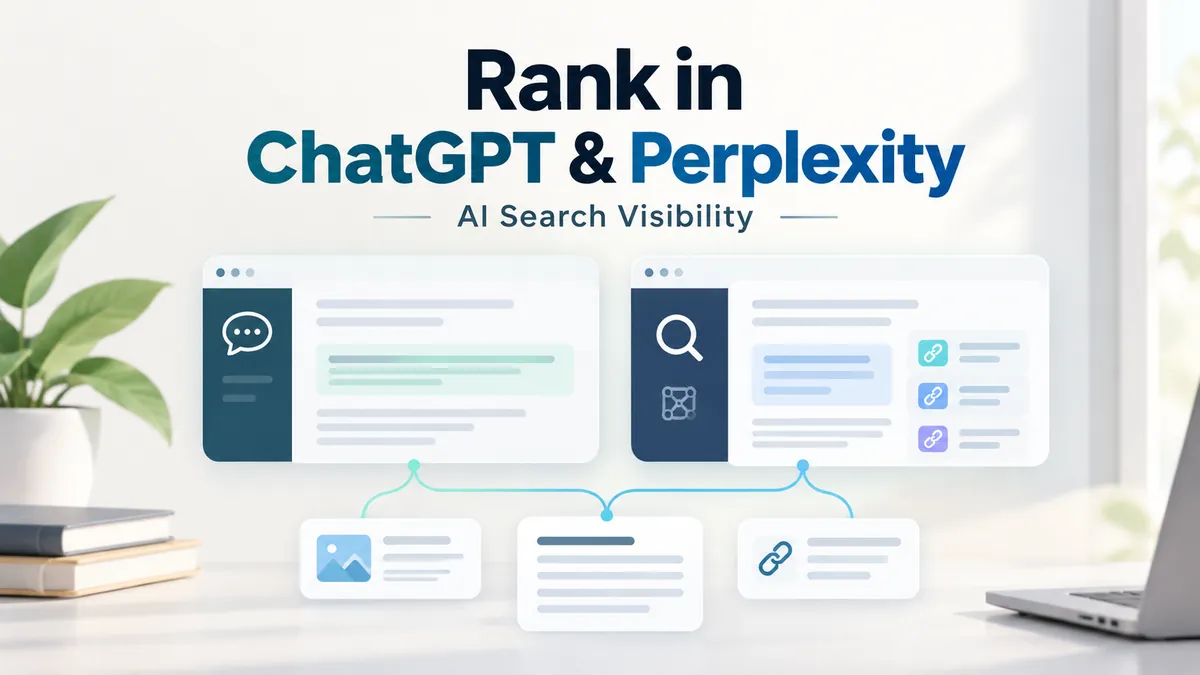
People are using ChatGPT and Perplexity to find businesses, compare services, research products, and decide what to do next. That creates a new search opportunity for businesses, and a new discipline worth understanding: ChatGPT SEO and Perplexity SEO.
You may have strong Google rankings and still be missing when someone asks ChatGPT, “Which SEO agency should I hire in Islamabad?” or “Which SEO company can help a real estate business in Pakistan?” ChatGPT and Perplexity don’t work like a Google results page. There’s no fixed position number one to target. The practical goal is to make your business more likely to be found, mentioned, recommended, cited, and linked when your information matches the user’s question.
What “Ranking” in ChatGPT and Perplexity Actually Means
Google gives you search positions; AI search works differently. A person can ask ChatGPT the same question twice and get different sources or wording, and Perplexity can return different sources depending on the question and available web results. So instead of watching one ranking position, track four things: is your business mentioned, is it recommended, is your website cited, and does the user click through? This is why ChatGPT SEO is better understood as AI search visibility rather than a fixed ranking number. For a full breakdown of our approach to SEO, see Growthkeel SEO Services.
How ChatGPT and Perplexity Find Website Sources
AI search tools need information to answer questions. When web search is involved, the system retrieves information from websites and uses relevant sources in its answer. OpenAI says public websites can appear in ChatGPT Search, and recommends allowing OAI-SearchBot access if you want your content discovered and included in ChatGPT summaries and snippets. Perplexity also uses web retrieval and displays sources with its answers, and its published technical documentation explains how its system crawls and processes web pages.
This means your website needs two things: search systems must be able to access the important information, and they must understand what the page is about.
Build the SEO Foundation for AI Search
You don’t need to abandon traditional SEO to work on Perplexity SEO or ChatGPT SEO. Google says its normal SEO fundamentals still apply to AI features in Search.
Foundation Checklist
- Make important pages crawlable and indexable
- Match every page to a real search need
- Build useful internal links
- Fix duplicate pages and broken redirects
- Keep valuable information in readable text
- Use clear titles and headings
- Support important claims with reliable sources
Why This Matters
Good SEO gives search systems a clearer picture of your website, services, topics, and business this is the same foundation both ChatGPT and Perplexity rely on when deciding what to cite.
For a practical look at how technical SEO, search intent, content, and authority work together, visit the Growthkeel SEO hub.
Make Your Website Easy to Crawl and Understand
Check OAI-SearchBot
OpenAI says websites that want their content included in ChatGPT summaries and snippets should not block OAI-SearchBot. Check your robots.txt file, firewall, CDN, bot protection, noindex settings, and server responses.
Check PerplexityBot
Perplexity publishes information about its crawler and confirms PerplexityBot follows robots.txt rules. Make sure your site isn’t accidentally blocking it.
Check Your Normal Technical SEO
Review your XML sitemap, canonical URLs, internal links, redirects, JavaScript rendered content, mobile usability, and structured data. Google has stated there’s no special markup required for its AI search features, and that llms.txt is not required for Google Search.
Create Content That AI Search Can Understand and Cite
The simplest approach is to answer the question clearly, then support the answer. A weak answer says something like “our company provides innovative SEO solutions designed to transform your online presence.” A useful answer explains the actual cost factors: website condition, competition, number of locations, content requirements, technical work, authority building, and ongoing monthly work.
Show Real Experience
- Use examples from actual projects
- Add original research when you have it
- Name the author when their experience is relevant
- Explain complicated subjects in simple language
- Keep information current
Google’s Guidance on This
Google’s current guidance says useful and original content matters for its generative search features, and warns against publishing large volumes of content mainly to manipulate search systems.
For content strategy and intent focused writing, see Growthkeel Content Marketing Services.
Build Brand, Entity, and Authority Signals
Your website is only one part of your online presence. People may discover your business through websites, publications, directories, reviews, videos, and social platforms, so your business information should stay consistent across all of them.
Useful Authority Signals
- Clear company information
- Named authors with relevant experience
- Real case studies
- Relevant backlinks
- Industry publications
- Accurate business directories
- Genuine customer reviews
- Original research
- Useful third party references
What to Avoid
Don’t create fake mentions or low quality placements to influence AI results. Earn references because the business has something genuinely useful to say or offer.
See Growthkeel Case Studies for examples of how SEO, paid advertising, local search, and conversion work connect to real business outcomes.
Optimize for Local AI Search
Local businesses have another layer to consider. Your website should make the relationship between business, service, location, industry, experience, and evidence explicit. For example: “Growthkeel is a digital marketing agency based in Islamabad, Pakistan, serving businesses in Pakistan and international markets” — see how this looks in practice on the SEO services for US businesses page.
Local Ranking Factors
Google says local results are mainly influenced by relevance, distance, and prominence. Complete business information, reviews, and links all contribute to local visibility.
Avoid Generic City Pages
Don’t create a city page simply by swapping one city name for another. An Islamabad page should contain useful Islamabad information, a Lahore page should address Lahore customers, and a Toronto page should reflect the Canadian market.
Growthkeel’s own Islamabad digital marketing services page is built around this exact business-service-location-evidence structure.
ChatGPT SEO vs. Perplexity SEO: What Should You Optimize Differently?
You don’t need two completely separate campaigns. The foundation for ChatGPT SEO and Perplexity SEO is largely the same: accessibility, content that answers real questions, clear business information, supported claims, and relevant authority.
Comparison: ChatGPT vs. Perplexity
| Factor | ChatGPT | Perplexity |
|---|---|---|
| Source discovery | Uses live web search when needed | Strongly retrieval-based by design |
| Citation display | Sources not always shown to user | Citations shown prominently with every answer |
| Crawler to allow | OAI-SearchBot | PerplexityBot |
| Referral tracking | Auto-added | No standard UTM auto-tagging confirmed |
| Best optimization focus | Broad authority + fresh content | Clear, directly quotable, well-structured answers |
| Consistency across queries | Same question can return different sources | Same question can also vary by retrieval pass |
How to Measure ChatGPT and Perplexity Visibility
Don’t measure this work only through Google rankings. Build a list of real customer questions and test them regularly.
What to Track Each Month
- Whether your business is mentioned
- Whether your website is cited
- Which pages are cited
- Which competitors appear
- The date of each test
- Referral traffic where measurable
Tools That Support This
Bing Webmaster Tools now has an AI Performance report showing cited pages, citation activity, and grounding queries. OpenAI notes that referral URLs can include a parameter to help identify ChatGPT referrals in analytics.
Common ChatGPT and Perplexity SEO Mistakes
Treating AI Search Like Google
There’s no fixed ChatGPT position you can guarantee.
Stuffing Keywords
Repeating “ChatGPT SEO” in every paragraph doesn’t make a page more useful.
Publishing Hundreds of Thin Pages
More pages don’t automatically mean more visibility.
Creating Fake Mentions
Fake reviews and artificial mentions create problems rather than lasting trust.
Ignoring Technical SEO
A great article still needs to be accessible — crawling, indexability, and redirects still matter.
Chasing llms.txt as a Shortcut
Google says llms.txt isn’t required for Google Search visibility.
Measuring Only Google Rankings
AI search visibility involves citations, mentions, and referrals that a traditional ranking report won’t show.
Tools for Tracking AI Search Visibility
Free Tools
- Google Search Console for traditional search performance
- Google Analytics for referral traffic
- Bing Webmaster Tools for AI Performance data
- Manual testing in ChatGPT and Perplexity
For Larger Sites
Specialist visibility platforms can help track many prompts and competitors at once, but the tool matters less than having a consistent process.
Is SEO Still Important for AI Search in 2026?
Yes. Traditional SEO remains the foundation for AI search. Google says its existing SEO fundamentals apply to AI Overviews and AI Mode, and Bing has introduced tools connecting normal webmaster data with citation activity in AI generated answers. If you want Growthkeel to review where your website is losing organic and AI search visibility, contact the Growthkeel team for a full audit.
A Practical 2026 Checklist
Technical
- Important pages can be crawled
- OAI-SearchBot and PerplexityBot aren’t blocked
- Pages are indexable
- The XML sitemap works
- Internal links reach important pages
Content
- Pages answer real customer questions
- Claims have reliable support
- Authors and experience are clear
- Old information is reviewed and updated
Authority
- Business information is consistent everywhere
- Relevant sites mention the business
- Reviews are genuine
- Case studies contain real information
Local
- Google Business Profile is complete and accurate
- Location pages provide real local value
- Citations are consistent
- Customers can easily contact you
Measurement
- Real customer prompts are tested monthly
- Mentions, citations, and competitors are recorded
- Referral traffic is checked regularly
Final Takeaways
There’s no single trick that guarantees a business appears in ChatGPT or Perplexity. The stronger approach is building a website that search systems can access, understand, verify, and reference.
If your business is in Islamabad, Lahore, Karachi, or another Pakistani city, don’t copy a generic international SEO page and add the city name. Explain the local market, use the language customers actually use, and show local proof.
If you want Growthkeel to review where your website is losing organic and AI search visibility, contact the Growthkeel team for a full audit.
A strong ChatGPT SEO and Perplexity SEO strategy starts with the same thing good SEO has always needed: useful information that people can trust.
Frequently Asked Questions
Is there a fixed ranking position in ChatGPT or Perplexity?
No. The same question can return different sources or wording, so there is no position number one to target. Instead, track whether your business is mentioned, whether it is recommended, whether your website is cited, and whether the user clicks through.
Do I need to allow OAI-SearchBot and PerplexityBot?
Yes, if you want your content discovered and included. OpenAI says websites that want to appear in ChatGPT summaries and snippets should not block OAI-SearchBot, and Perplexity confirms PerplexityBot follows robots.txt rules. Check your robots.txt file, firewall, CDN, bot protection, noindex settings, and server responses.
Do I need llms.txt or special markup to appear in AI search?
Google has stated that no special markup is required for its AI search features, and that llms.txt is not required for Google Search. Strong technical SEO, clear content, and reliable sources matter more than shortcuts.
How do I measure ChatGPT and Perplexity visibility?
Build a list of real customer questions and test them regularly, ideally every month. Record whether your business is mentioned, whether your website is cited, which pages are cited, which competitors appear, the date of each test, and referral traffic where measurable. Bing Webmaster Tools also has an AI Performance report showing cited pages and citation activity.
Should I create a separate page for every city?
Not by simply swapping one city name for another. An Islamabad page should contain useful Islamabad information, a Lahore page should address Lahore customers, and a Toronto page should reflect the Canadian market. Each page should offer real local value.