Updated October 2026 · Written by Tauseef Shah, founder and CEO of Growthkeel
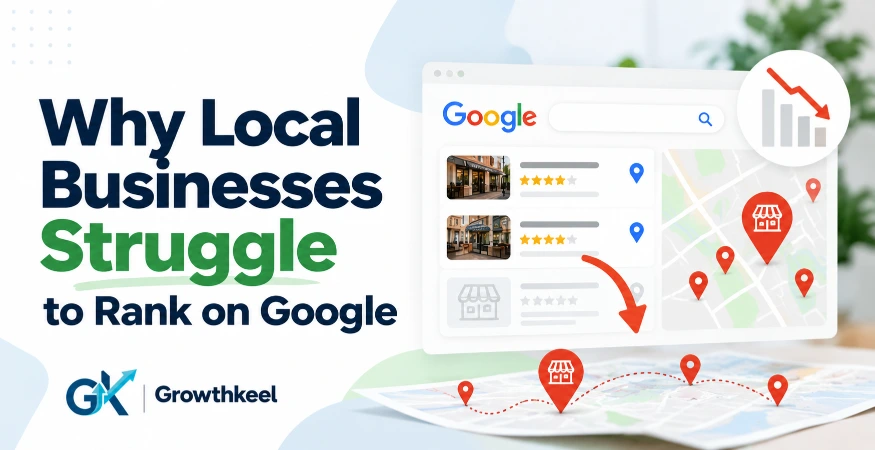
A good business can still be hard to find on Google. You may have loyal customers, strong reviews, a useful website, and years of experience. Yet a competitor can still appear above you when someone searches for the exact service you provide.
Why local businesses struggle to rank is rarely a question with one answer. Google says local results are mainly influenced by relevance, distance, and prominence. Your Business Profile information, website, reviews, links, location, and other online signals all help Google understand where your business fits.
This matters to millions of small businesses. In Canada, there were 1.08 million small employer businesses as of December 2024, representing 98.2% of employer businesses. More than three quarters had fewer than 10 employees.
For a small business owner in Toronto, Vancouver, Calgary, or another Canadian city, the real question is not simply how to rank. It is what is stopping the right local customer from finding this business when they search for what it sells.
Not sure where your business stands right now? Book a free local SEO consultation with Growthkeel and get a clear diagnosis before changing anything on your site.
Why Do Local Businesses Struggle to Rank on Google?
The short answer is that Google needs enough reliable information to understand what a business does, where it operates, and how relevant and prominent it is for a particular search. Common problems include an incomplete Google Business Profile, weak service relevance, and thin service pages. Inconsistent business information, few local references, and limited reviews also hold businesses back. Technical issues, stronger competitors, or targeting the wrong service area round out the usual suspects.
Google also makes an important point. There is no way to pay for a better local ranking. Local results are based on relevance, distance, and prominence, not ad spend. That means the first step is finding the actual problem rather than adding another random SEO tactic. A full SEO audit is the fastest way to separate the real issue from guesswork.
How Google Decides Which Local Businesses to Show
Google describes local ranking through three main ideas: relevance, distance, and prominence. Each one plays a different role, and a weakness in any single area can quietly cap how often a business appears. Understanding what each term actually means is the fastest way to know where to look first.
Relevance means how closely a business matches what someone searched for. If a person searches for an emergency plumber in Toronto, Google needs to understand that the business actually provides emergency plumbing services in that city. A profile that simply says plumbing company gives Google far less to work with than a complete business presence that clearly explains its services and service area.
Distance refers to how far a business is from the person searching. This is why local rankings shift from one neighborhood to another, since Google factors in the searcher’s location when deciding which businesses are relevant nearby. A business near North York may not show the same visibility for a search made from downtown Toronto.
Prominence is about how well known a business appears to be. Google says this can be influenced by links from other websites and by reviews, with more reviews and positive ratings helping local ranking. Reviews are only one part of the picture, though. Local SEO is not just Google Business Profile work. A website, reputation, links, and wider online presence all factor in together, which is why local SEO and Google Business Profile management usually needs to be handled as one connected system rather than separate tasks.
Is Your Google Business Profile Sending the Right Signals?
A Google Business Profile is often the first place to check. Google recommends keeping business information complete and accurate, and specifically warns that inaccurate information can prevent a profile from appearing for relevant searches in the area. A profile should describe the real business rather than serve as a place to stuff every keyword worth ranking for.
For example, a dental clinic in Vancouver should make it immediately clear that it is a dental clinic, what treatments it offers, and where customers can find it. That same information should stay consistent across the website and other important business listings. Two areas worth checking first are whether the primary category truly matches the core service, and whether the listed services reflect what the business actually does day to day.
Why Does My Business Rank for Its Name but Not Its Services?
This is one of the most useful ways to diagnose a local SEO problem. Suppose a business is called Maple Dental Care. A search for Maple Dental Care Vancouver brings it up without trouble. But a search for dentist Vancouver shows no sign of it at all.
That does not mean Google cannot find the business. It usually means Google has weaker evidence connecting that business to the broader service search. The gap often sits in the Business Profile category, the listed services, the service pages themselves, or the page titles and headings used across the site. Customer reviews and relevant local mentions play a role here too, since they reinforce the same service to business connection Google is trying to confirm.
A website should clearly explain what a business actually offers, in language that matches how customers search rather than internal jargon. This is exactly the gap that keyword research and search intent mapping is meant to close, connecting a given search to the right service, product, location, and supporting page.
Why Isn’t My Website Helping My Local Rankings?
A local business website does not need hundreds of pages. It needs the right pages with genuinely useful information. A strong service page answers what the service is, who it is for, where it is offered, and what a customer should expect from start to finish.
A Toronto roofing company, for instance, benefits far more from one useful page about roof replacement than from a generic page listing every roofing service it offers. The same logic applies to location pages. A page titled Roofing Services in Toronto should contain real, useful information about that specific service and market. Swapping Toronto for ten different city names and publishing nearly identical pages adds very little value and can actively work against a site.
Internal links matter here too, since they help both people and search engines move between related pages. This kind of page level planning is usually where content marketing and service page strategy makes the biggest difference, since it connects search intent, service pages, and internal linking into one structure instead of a pile of disconnected pages. Google has also noted that structured data can help it understand information on a page, with LocalBusiness structured data describing details such as hours and other business information.
Does Inconsistent Business Information Hurt Local Visibility?
Business information should stay accurate everywhere customers and search engines might encounter it, including name, address, phone number, website, hours, category, and services. An outdated phone number on one directory, or an old address sitting on another, can quietly create confusion for both Google and customers. This does not mean submitting a business to hundreds of random directories. It means focusing on the handful of sources that are actually relevant and trustworthy. Complete, accurate profile information consistently improves the odds of appearing in relevant local searches.
Why Does My Competitor Rank Higher Than My Business?
This is where many business owners start hunting for a secret ranking trick. Usually, the better question is simpler. What is actually different between this business and the ones Google is already showing? Comparing business category, services, website quality, reviews, and local mentions across competitors tends to reveal the real gap far faster than guessing.
It is worth resisting the assumption that the competitor with the most reviews must automatically rank first. Google has never described local ranking as a pure review count contest. Its published framework centers on relevance, distance, and prominence together. One competitor may simply be closer to the searcher. Another may have stronger service relevance, and another may carry a wider local reputation built over years. A structured SEO consultant approach for Canadian businesses tends to work better here than a one off audit, since competitor research works best when it looks at the whole search presence at once, not a single metric in isolation.
Do More Reviews Guarantee Better Local Rankings?
No. Reviews help, but they are not the entire local SEO system. Google has confirmed that review count and positive ratings contribute to prominence, which is only one of three ranking factors at play.
The right approach is collecting genuine feedback from real customers rather than buying or manufacturing reviews. Good review management also means responding professionally and paying attention to what customers repeatedly mention. If customers keep praising fast emergency service, for example, that is a signal worth reflecting in the business’s own marketing. The reviews themselves should stay an honest record of real experience, not a keyword placement exercise.
Why Do I Rank in One Neighborhood but Not Another?
Local rankings are not one fixed position that applies everywhere. A business can appear strongly near its own location and grow far less visible only a short distance away. Picture a physiotherapy clinic in downtown Vancouver. Someone searching two blocks away is likely to see it prominently, while someone searching from another part of the city may see entirely different businesses instead.
This happens because distance is one of Google’s stated local ranking factors, not an accident of the algorithm. It is also why checking a ranking from a single computer or location never tells the full story of how customers across a service area actually see Google’s results. Serious local research means checking the important searches from every area a business genuinely serves.
Can Technical SEO Stop a Local Business From Ranking?
Yes. Technical problems can make important pages harder for search engines to access, understand, or index in the first place, and no amount of content or reviews fixes a page Google cannot properly crawl. Two of the most common culprits are pages that were never indexed and important pages with no internal links pointing to them, though slow load times and mobile usability issues cause plenty of damage too.
Google Search Console exists specifically to help site owners monitor search performance and confirm whether Google can index their pages. Structured data can also help Google understand what is on a page, though adding markup on its own never guarantees a special search appearance. When technical problems are suspected, a proper technical SEO audit is far more useful than guessing which keyword to add next.
Why Am I Ranking but Still Not Getting Calls or Leads?
A ranking is not the same thing as a customer. The real path runs from search to visibility, then to a click, a website visit, trust, an enquiry, and finally a customer, and a business can do well on the first two steps while still losing people somewhere further along.
Common breakdowns include a keyword with little buying intent, a page that does not actually answer the customer’s question, or a phone number that is hard to find. A slow website, an unclear service page, or the absence of a clear next step can each quietly cost leads on their own. This is exactly why SEO reporting should never stop at rankings. Connecting search performance to real business outcomes such as calls, forms, bookings, and purchases is what actually shows whether the work is paying off.
Is Local SEO Still Important in 2026?
Yes, but local search is not standing still. Google continues to add AI driven features alongside traditional search, and its own documentation now treats AI search experiences as an extension of core Search practices rather than something separate. Google has also confirmed that AI Overviews and AI Mode draw on web sources to generate their answers.
For local businesses, that makes clear business information more valuable than ever. A site should make it obvious who the business is, what it offers, where it operates, who it serves, and what evidence backs up its claims. Local SEO and answer engine optimization are increasingly the same job rather than two separate ones. Both depend on clear entities, answer ready content, and structured, verifiable information, which is the core of how GEO and AI search optimization is approached alongside traditional SEO rather than instead of it.
What Should I Check First if My Local SEO Isn’t Working?
Google Business Profile and Service Relevance
Start by confirming the Business Profile is complete and accurate, since incomplete information is one of the most common reasons a business stays invisible. Alongside that, check whether a customer, and Google, can clearly understand what the business actually sells. These two checks alone resolve a surprising share of local visibility problems.
Pages, Indexing, and Reputation
Next, confirm that the main service and location pages exist, are genuinely useful, and can actually be found. Google Search Console will show whether those pages are indexed at all, which is worth checking before assuming a content problem. From there, review genuine customer feedback and the business’s wider online presence to see whether reputation is pulling its weight.
Competitors and Conversions
Finally, compare the business against whichever competitors actually appear for its target searches, rather than assuming it already knows who the real competition is. Then check whether existing visibility is producing calls, forms, bookings, or sales. A ranking with no conversion trail usually points to a problem further down the funnel. Working through these checks in order, rather than changing ten things at once, makes it far easier to identify what is actually holding a business back.
AEO and AI Overview: How the Signals Compare
Local rankings and AI generated answers are judged by overlapping but distinct signals. The table below breaks down where they align and where they diverge.
| Signal | Traditional Local Ranking | AEO / AI Overview Citation |
|---|---|---|
| Primary driver | Relevance to query, physical distance, prominence from reviews and links | Semantic completeness, meaning a self contained passage that fully answers the query |
| Content format | Full service and location pages | Short, extractable answer blocks of roughly 130 to 170 words |
| Reviews | Direct ranking input through prominence | Indirect, feeding sentiment and trust rather than triggering a citation directly |
| Structured data | Helps Google understand page content | Helps AI systems parse and trust entities and facts |
| Backlinks | Core prominence signal | Weighted less than contextual mentions and citations |
| Off site mentions | Secondary signal such as citations and directories | Major signal, since Reddit, YouTube, and Wikipedia mentions count even without a link |
| Freshness | Helpful but not dominant | A strong factor, since content updated within three to twelve months performs notably better |
| Rank number one organically | Directly correlated with visibility | Only weakly correlated, since the top organic position gives just a 17 to 54 percent chance of AI citation |
Frequently Asked Questions
Why is my business not showing up on Google Maps? This usually points to a weak or incomplete Google Business Profile, a mismatched primary category, or a lack of prominence signals such as reviews and links. Distance from the searcher can also play a role.
How long does it take to rank higher in local search? There is no fixed timeline, since it depends on how far behind a business currently is on relevance, distance, and prominence. Fixing technical and profile issues can show movement within weeks, while building reputation and links takes longer.
Do I need a website to rank in local search? A Google Business Profile alone can appear in local results, but a proper website with clear service pages strengthens relevance and prominence, and gives Google more evidence to work with.
Does adding more keywords to my Google Business Profile help? No. Google recommends describing the real business accurately rather than stuffing extra keywords into the profile. Inaccurate or misleading information can hurt visibility instead of helping it.
Are backlinks still important for local SEO? Yes, backlinks remain a core part of prominence. Their role has evolved alongside reviews and citations, but they have not disappeared as a ranking signal.
How is AEO different from traditional local SEO? Traditional local SEO focuses on relevance, distance, and prominence to rank in search results. AEO focuses on structuring content so AI systems can extract, trust, and cite it directly in generated answers, which does not always match traditional rankings.
Conclusion
The real answer to why local businesses struggle to rank is rarely a missing keyword. A business needs Google to understand its services, location, relevance, and prominence, and increasingly it needs AI systems to trust the same information for a different reason entirely. The best starting point is always a diagnosis across relevance, distance, prominence, website quality, technical health, reputation, competition, and conversion. Fixing the problem that is actually holding a business back matters far more than adding another tactic on top.
Ready to find out exactly what’s holding your business back? Talk to Growthkeel about a full local SEO and GEO audit and get a clear, prioritized action plan.